Is Flexpeptides legit? An independent review
Flexpeptides states its peptides are 'third-party tested' / 'lab tested' to ≥99% but never names the lab and publishes no verifiable certificate. A purity claim with no lab, no document and no verification link is just a number on a product page, the buyer is asked to take quality entirely on trust.
Which UK sellers do pass this check?
Verified facts at a glance
| Fact | What we found | How it was checked |
|---|---|---|
| Standard applied | own-name verifiable-COA standard | how every vendor is judged, methodology |
| Certificate | 🚩 self-made / in-house | read on the seller's own site |
| Domain registered | Jan 2026 · 8 months old | the domain registry's public record |
| This audit as data | /data/vendor/flexpeptides-co-uk.json | same record the open dataset serves, re-checked daily |
- A certificate that verifies in this seller's own name on an independent laboratory's website
- Any report from a named independent laboratory: the published 'COA' is the seller's own document
The certificate, and what's wrong with it
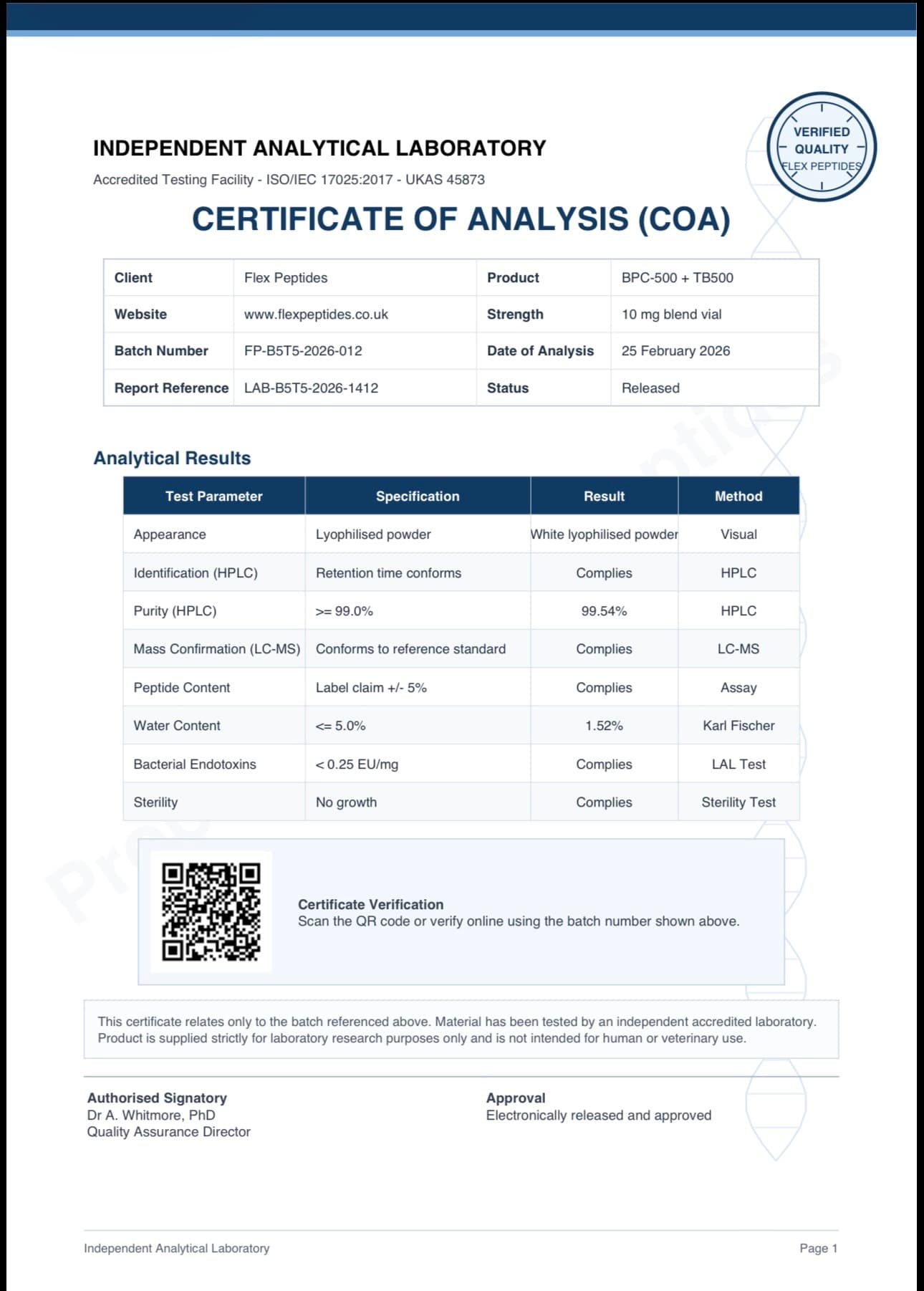
Is Flexpeptides legit? The questions people ask
Is Flexpeptides legit?
Flexpeptides (flexpeptides.co.uk) is on The Peptide Watch's watch list. It does not publish a certificate of analysis that can be independently verified in its own name, so its quality claims rest on trust rather than checkable evidence. That is not proof of a scam; it means the evidence does not check out.
Can I trust Flexpeptides, and is it a good supplier?
You cannot independently verify its testing today. A good delivery reputation is not the same as a verifiable certificate; the two are unrelated. Until Flexpeptides publishes an own-name certificate you can check on an independent lab's website, you are taking its quality on trust.
Is Flexpeptides a scam?
The Peptide Watch does not assert that. What is observable is the reason it sits on the watch list: no named lab, nothing to verify. Being unverifiable is a reason for caution, not proof of fraud.
Does Flexpeptides publish a real, verifiable Certificate of Analysis?
Not one that can be independently verified in its own name. They claim 'third-party / lab tested' but never name the lab and publish no verifiable certificate, an unnamed, unpublished test is just a marketing claim.
Which UK peptide sellers do publish a verifiable certificate of analysis?
Of the 446 active UK sellers The Peptide Watch audits, 38 publish a certificate of analysis you can verify in their own name on the independent laboratory's own website. Ranked by most recent certificate, they are Lab77Peptides, Peptology Labs, Biovanta, Camo Chem, Biohackpeptides and 33 others. This is a record of who publishes verifiable paperwork, not a recommendation.
Related vendors
Compare with independently-tested vendors: Is Lab77Peptides legit? · Is Peptology Labs legit? · Is Biovanta legit?
The Peptide Watch. "Is Flexpeptides legit? Independent review & COA audit." Verified 30 September 2026. https://thepeptidewatch.com/vendor/flexpeptides-co-uk